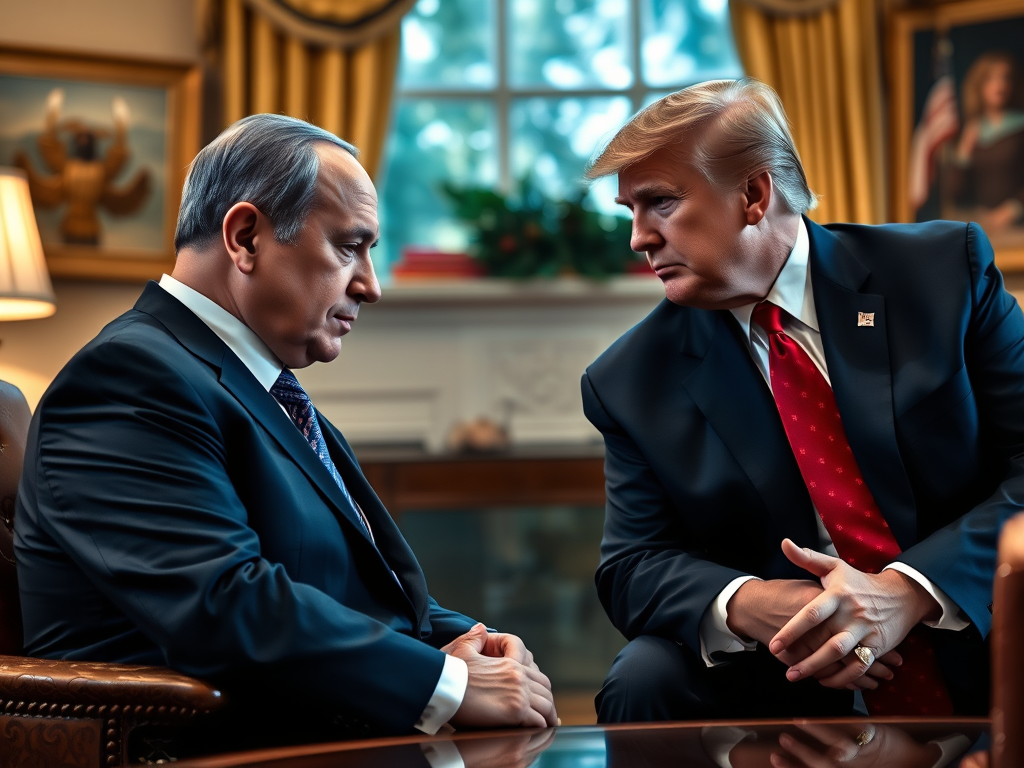
President Donald Trump is scheduled to meet with Israeli Prime Minister Benjamin Netanyahu on Tuesday, marking Netanyahu as the first foreign leader to engage with Trump following the commencement of his second term.
During a briefing with reporters on Sunday, Trump characterized the forthcoming discussion at the White House as a “very big meeting.” In his invitation letter to Netanyahu last week, he expressed, “I look forward to discussing how we can bring peace to Israel and its neighbors, as well as our collaborative efforts to address mutual adversaries.”
Netanyahu indicated on Sunday that the agenda will include “critical issues that lie ahead of us — defeating Hamas, ensuring the return of all our hostages, and addressing the Iranian axis in all its dimensions, which poses a threat to Israel’s security, the Middle East, and the global community.”
The meeting is set for 4 p.m. ET, followed by a joint press conference approximately one hour later.
Trump’s transition team played a pivotal role in facilitating a ceasefire and hostage release agreement between Israel and Hamas, with the next phase of this agreement anticipated to be a focal point of discussion between the two leaders on Tuesday.
The current conflict escalated on October 7, 2023, when Hamas executed a terrorist attack on Israel, resulting in the deaths of 1,200 individuals and the abduction of 251 hostages. In response, Israel launched extensive air and ground operations in Gaza, leading to over 47,000 fatalities, predominantly among civilians, according to local officials. This military response has displaced hundreds of thousands of Palestinians.
The magnitude of Israel’s counteroffensive has attracted international criticism; however, Netanyahu has staunchly defended his government’s actions, most recently while en route to Washington. “The decisions we have made during the war, in conjunction with the valor of IDF soldiers, have fundamentally altered the landscape of the Middle East. I believe that by working diligently with President Trump, we can effectuate further positive changes,” Netanyahu remarked.
Trump has expressed a desire for Jordan and Egypt to accept a greater number of Palestinian refugees as part of an initiative to “clean out” Gaza.
Although Netanyahu and Trump were strong allies during Trump’s first term, their relationship experienced tension following Netanyahu’s congratulatory message to Joe Biden after the 2020 election while Trump was still contesting the results. Shortly after the October 7 attack, Trump criticized Netanyahu at a campaign rally, stating that he had “let us down” during his previous administration, particularly in the context of U.S. actions against Iranian leadership. Despite this, Trump later reaffirmed his support on social media with the hashtags “#IStandWithIsrael” and “#IStandWithBibi,” referencing Netanyahu’s nickname.
Their relationship appeared to improve in July when Netanyahu visited Trump at his residence in Florida following his meetings with Biden and Vice President Kamala Harris, as well as after a failed assassination attempt on Trump.
Netanyahu noted on Sunday that “the significance of this being [Trump’s] first meeting with a foreign leader since his inauguration is profound for the state of Israel” and “demonstrates the enduring strength of the alliance between Israel and the United States.”
This visit marks yet another occasion for Netanyahu at the White House. Upon his arrival at Blair House, the historic official guest residence, its director indicated that this is Netanyahu’s 14th visit, a number that surpasses that of any other foreign leader since the residence’s establishment in the 19th century.
 World Today
Leave a comment